🧨 Introduction | Why Nuclear Tests 2025 Matters
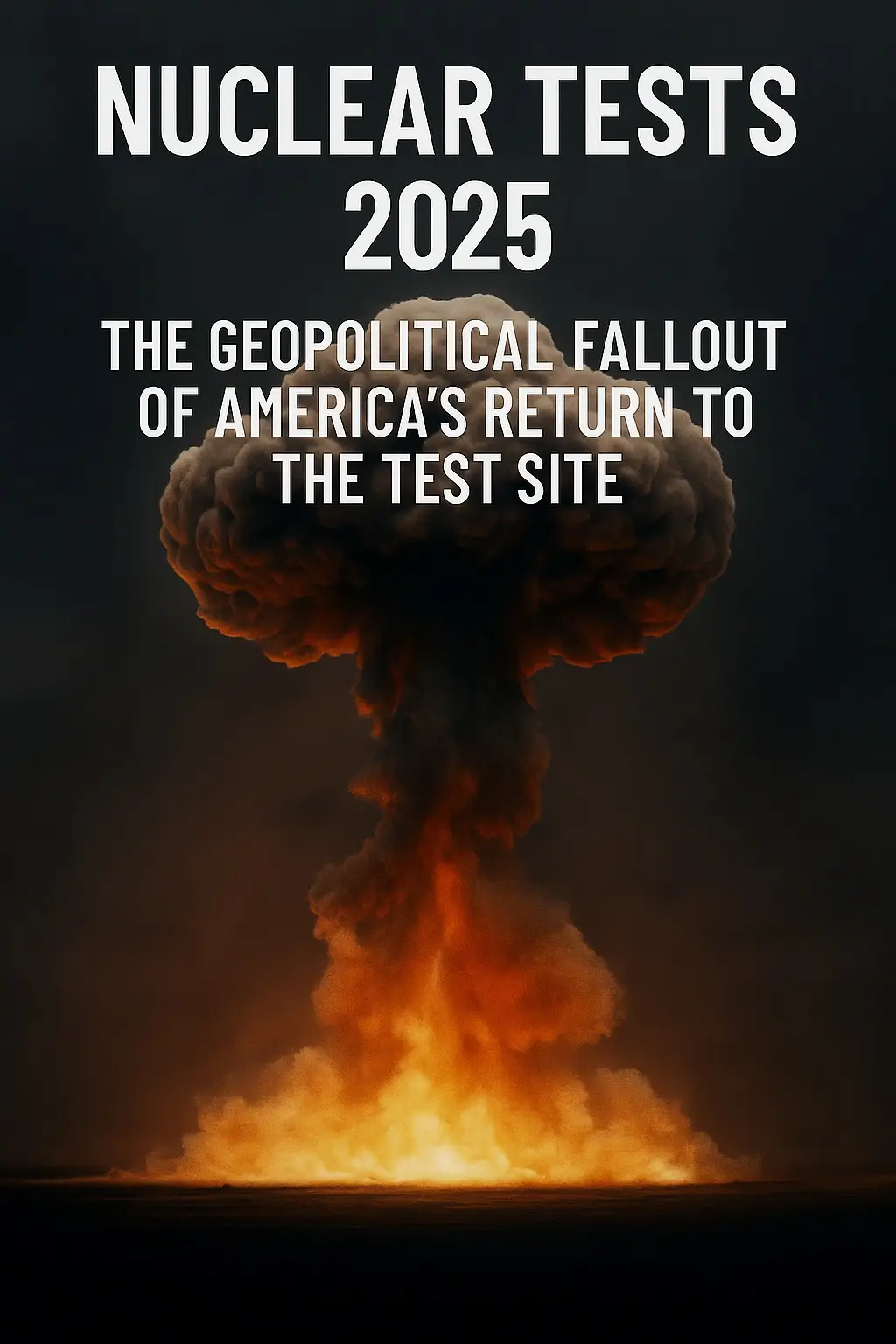
In October 2025, the United States resumed underground nuclear weapons testing for the first time in more than three decades. Announced under the directive of former President Donald Trump, this step has unsettled global power balances.
Experts argue that Nuclear Tests 2025 may reshape the security landscape, reopen the nuclear arms race, and undermine confidence in non-proliferation regimes painstakingly built since the end of the Cold War.
For many, Nuclear Tests 2025 signals not merely a technical exercise but a strategic declaration: that deterrence, not disarmament, once again defines American defense thinking.
🌍 Historical Context | Breaking a 33-Year Silence
The last U.S. nuclear detonation occurred in September 1992 at the Nevada Test Site. Soon after, Washington halted full-scale testing and championed the Comprehensive Nuclear-Test-Ban Treaty (CTBT), adopted in 1996. Although the CTBT bans all nuclear explosions, key nuclear powers — including the U.S., China, India, Pakistan, and North Korea — never ratified it, leaving enforcement incomplete.
Through the late 1990s and 2000s, subcritical experiments replaced real detonations. But the steady rise of North Korea’s open tests and Russia’s experimental warhead programs slowly eroded the informal moratorium. Against this backdrop, Nuclear Tests 2025 represents the first break in a fragile consensus that restraint, not rivalry, preserved stability.
⚠️ Why the U.S. Resumed Nuclear Tests 2025
Three interconnected motives appear behind Washington’s decision:
Strategic Parity and Deterrence
Defense planners argue that Nuclear Tests 2025 restores credibility of deterrence amid rapid Russian and Chinese modernization. Moscow’s “super-weapon” claims — from nuclear-powered torpedoes to hypersonic glide vehicles — have fueled concern that simulation-only approaches leave America behind.
Reliability of an Aging Arsenal
More than 90 % of U.S. warheads were designed before 1990. Laboratories contend that digital modeling alone cannot indefinitely guarantee performance. Nuclear Tests 2025 therefore serves as a “confidence test” verifying that deterrent forces remain viable without deploying new weapons.
Political and Symbolic Messaging
The tests also carry diplomatic symbolism. Conducted just ahead of defense summits and elections, Nuclear Tests 2025 projects strength to allies while signaling rivals that the U.S. retains technical supremacy. For critics, however, it marks a dangerous political gamble that trades stability for optics.
🌐 Global Reactions to Nuclear Tests 2025
Reactions have been swift and divided:
Russia condemned the move as “a return to confrontation,” while boasting of its own nuclear-capable cruise-missile demonstrations.
China called for “maximum restraint,” warning that Nuclear Tests 2025 could unravel decades of arms-control dialogue.
Iran labeled it “a provocation threatening world peace,” accusing Washington of hypocrisy after years of sanctioning others for similar acts.
European Union leaders expressed disappointment, urging renewed commitment to the CTBT.
UN Secretary-General António Guterres voiced “deep regret,” cautioning that Nuclear Tests 2025 risk turning the CTBT into “a forgotten promise.”
The geopolitical tone is unmistakable: while Washington frames Nuclear Tests 2025 as technical necessity, most of the world views it as a strategic regression.
🔬 Technological Implications of Nuclear Tests
Technologically, Nuclear Tests 2025 bridges physical experimentation with next-generation science:
From Subcritical to Low-Yield Tests — Analysts expect controlled micro-detonations that collect data on fusion behavior without large blasts.
Miniaturization & Delivery Systems — Insights from Nuclear Tests 2025 may refine compact warheads for hypersonic or drone-based platforms.
AI and Quantum Simulations — Machine-learning algorithms trained on real-test data could model radiation flow and fissile-material aging with unprecedented accuracy.
Civil Spin-offs — Ironically, data from Nuclear Tests 2025 may advance materials science and fusion-energy research, though critics argue such benefits do not justify renewed explosions.
Together these trends illustrate how Nuclear Tests 2025 merges old physics with new computing, altering both warfare and research frontiers.
🧭 Strategic and Ethical Dimensions of Nuclear Tests 2025
Beyond science, profound strategic and moral questions emerge:
Escalation Risk — Each detonation invites reciprocal tests, reviving a spiral reminiscent of the 1950s arms race.
Diplomatic Erosion — Nuclear Tests 2025 weakens U.S. moral leverage in urging restraint from others, complicating negotiations with Iran or North Korea.
Environmental Consequences — Even underground tests risk radioactive seepage and seismic instability; regions surrounding old test sites remain contaminated decades later.
Ethical Dilemma — Does security justify renewed nuclear activity when non-nuclear deterrence and cyber defense offer alternatives?
For many observers, Nuclear Tests reopens a debate long thought closed: Can nuclear ethics coexist with national interest?
🧩 Regional Implications and Global Security Dynamics
Nuclear Tests 2025 reverberates far beyond U.S. borders:
Asia-Pacific: Japan and South Korea fear an arms cascade that could legitimize their own nuclear ambitions.
Middle East: Iran and Saudi Arabia may view this test as validation for expanding uranium-enrichment programs.
Europe: NATO allies are torn — welcoming deterrence but worrying about strategic instability near Russia’s frontier.
Developing Nations: The Non-Aligned Movement warns that global security agendas are again being dictated by a few powers, marginalizing humanitarian perspectives.
In effect, Nuclear Tests transforms nuclear deterrence from a strategic concept into a diplomatic dividing line.
📊 Economic and Scientific Costs
Resuming testing is not merely political—it is financially immense. Analysts estimate these tests will cost over $1.8 billion in site reactivation, containment facilities, and data analysis. These funds could alternatively finance nuclear cleanup, climate-adaptation research, or fusion energy initiatives.
Supporters counter that testing sustains thousands of high-skill scientific jobs and keeps national laboratories at the technological frontier. The debate thus extends from morality to economic prioritization: investment in deterrence versus investment in the planet’s future.
📣 Conclusion | The World After Nuclear Tests 2025
Nuclear Tests stands as both a technical milestone and a moral crossroad. It revives dormant questions about power, peace, and responsibility. Whether it ultimately strengthens deterrence or undermines collective security will depend on the diplomatic choices made in its aftermath.
The true challenge for global leadership lies not in perfecting the bomb but in re-engineering trust.
If nations respond with renewed dialogue — reviving the CTBT, improving verification, and recommitting to arms control — Nuclear Tests 2025 might become the catalyst for reform rather than rivalry.
If not, it could mark the start of a new atomic age where data replaces diplomacy and fear replaces faith.
The world is once again standing at the crossroads between deterrence and diplomacy.
If you found this analysis insightful, explore more from our Global Security Series — and subscribe for weekly analytical briefings on geopolitics, AI, and defense transformation.
For more blogs click here
Nuclear Test 2025 refers to the underground nuclear weapons tests conducted by the United States in October 2025, ending a 33-year moratorium that began after 1992. These tests were designed to assess weapon reliability and send a geopolitical message amid renewed great-power competition.
The official justification for Nuclear Tests centers on ensuring the reliability of aging warheads and maintaining strategic parity with Russia and China. Critics argue the tests also serve political signaling and risk eroding international non-proliferation norms.
Your point of view caught my eye and was very interesting. Thanks. I have a question for you. https://accounts.binance.info/zh-TC/register?ref=DCKLL1YD