
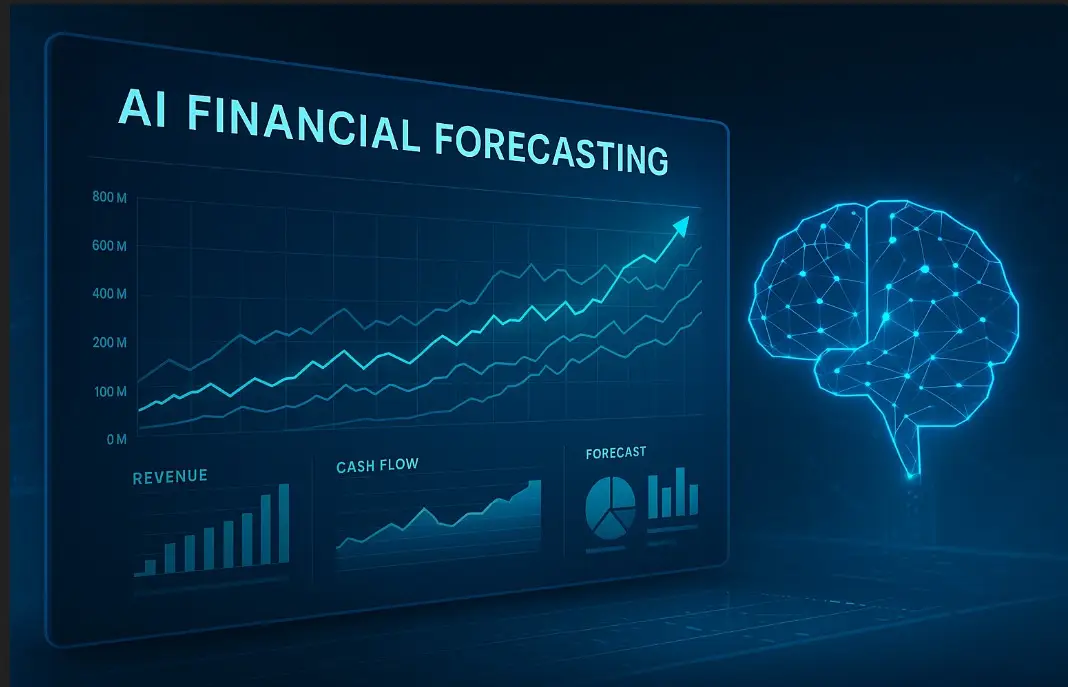
The Changing Landscape: AI Financial Forecasting
In 2025, the landscape of corporate finance and forecasting is in a transformation phase. Traditional forecasting frameworks—often reliant on manual inputs, static spreadsheets, and historical trend-analysis—are yielding to smarter systems. 📊 According to industry research, 80 % of large enterprise finance teams are expected to use internal AI platforms by 2026.
The term AI in financial forecasting is no longer an aspirational boutique initiative—it’s increasingly central to how CFOs, analysts and finance leaders must plan, consider risk, and optimally allocate resources. 🌐 As one analyst piece states: in 2025, AI will “play an even larger role in automating complex tasks, enhancing decision-making and providing real-time insights.”
For finance leaders, this means moving beyond descriptive reporting (“what happened”) toward predictive and prescriptive forecasting (“what will happen” and “what should we do”). 🚀
Why AI in Financial Forecasting Matters Now
🎯 Accuracy & Agility Gains
Advanced modelling techniques—such as machine learning and time-series foundation models—are dramatically improving forecast accuracy. 📈 Such gains matter because in volatile markets, rigid static models fail to respond to rapid shifts in demand, supply chain shocks, macro constraints or behavioural changes.
🕒 Real-Time Data and External Signals
AI is no longer restricted to internal historical financial statements. It draws on real-time data streams (market sentiment, alternative data, macro economics) and integrates them into forecasting frameworks. 💹 In effect, AI in financial forecasting invites a more dynamic, multi-factor view of future outcomes.
🧭 Strategic Value Beyond Automation
While automation of mundane forecasting tasks is a benefit, the strategic value of AI lies in scenario modelling, early warning signals, driver identification (what really moves revenue, cost, cash-flow) and enabling faster decision-making. 💼
Thus, deploying AI in financial forecasting elevates finance from backward-looking to forward-looking and strategic. 🌟
Core Components of an Effective AI-Enabled Forecasting Framework
🧱 Data Foundation
Historical internal financial data (income, balance sheet, cash flow)
Operational/driver data (sales pipeline, production output, cost metrics)
External/alternative data sources (macro-economics, market indices, consumer behavior, supply chain signals)
Clean, governed, aggregated and integrated in a usable format 🧹
🧠Model Selection & Architecture
Time-series models (traditional ARIMA, VAR) supplemented by ML/deep learning models (LSTM, attention-based).
Emerging “foundation models for time-series” are showing promise. 📚
Explainability and transparency (XAI) are critical for compliance and trust. 🔍
Scenario-modelling layers enable what-if analysis (e.g., “if cost rises 10%”, “if demand drops 15%”). 🧮
⚙️ Automation & Workflow Integration
Automated data pipelines: ingesting, cleaning, transforming, storing in data lakes.
Scheduled retraining of models when new data arrives or markets shift. 🔄
Integration with BI dashboards and alerts.
Feedback loops for model performance and drift detection. 🪄
🛡️ Governance, Ethics & Risk Management
Model risk oversight: bias detection, validation, audit trails.
Regulatory compliance and transparency are essential. 📜
Data privacy and ethical use of alternative data must be managed. 🔐
Step-by-Step Guide: Automating Forecasting with AI
Here is a practical roadmap finance leaders and analysts can follow to implement AI in financial forecasting:
Define objectives & KPIs 🎯
Inventory data sources & build foundation 🗂️
Select modelling and technology stack 🧩
Build and train models 🤖
Validate, deploy and integrate 🚀
Monitor, refine and govern 🧭
Scale and embed 🌍
Each step ensures accuracy, scalability, and trust in your forecasting process.
Key Use Cases Where AI Financial Forecasting Delivers Value
💰 Cash-flow forecasting & treasury management: anticipate liquidity stress early.
📊 Revenue forecasting under volatile demand: manage pricing and churn shifts dynamically.
📦 Cost/expense forecasting: adjust for supply chain disruptions and inflation.
🏗️ Capital expenditure planning: model ROI under multiple scenarios.
⚖️ Risk-adjusted forecasting: simulate shocks, regulatory changes, or macro events.
Challenges and Practical Considerations
⚠️ Data quality and availability: legacy systems and silos remain obstacles.
🤔 Model interpretability and trust: explainable AI builds confidence.
👥 Change management: require buy-in from FP&A and leadership teams.
🧾 Model governance: audit and control mechanisms are essential.
🤖 Overreliance on automation: human judgement must complement AI.
📈 Scaling responsibly: disciplined scaling ensures long-term success.
The Future: What’s Next for AI Financial Forecasting
🔮 Foundation models for forecasting: pretrained time-series models for finance.
👩💼 Hybrid human-AI forecasting teams: domain knowledge meets pattern recognition.
🌐 Digital twin finance: simulate multiple futures for decision loops.
⚡ Real-time forecasting: adapt instantly to new data inputs.
🧩 Embedded governance and explainability: transparency will be mandatory.
🏢 Wider democratization: SMEs will access AI forecasting once limited to enterprises.
🏁 Final Thought
For finance leaders, analysts and CFOs, deploying AI financial forecasting is no longer a luxury—it is a strategic imperative. 💼
The stakes are high: improved forecast accuracy, faster insights, agile resource allocation and stronger planning. Yet technology alone does not guarantee success. The real payoff lies in integrating data, models, governance and human insight into a cohesive forecasting ecosystem.
When done well, AI forecasting transforms finance from reactive to proactive—from descriptive to predictive—and from tactical support to strategic partner. 🌟
In today’s volatile and complex business environment, firms that harness the power of AI financial forecasting will anticipate change rather than be surprised by it. 🌍
👉 I encourage you to evaluate where your organisation stands, identify high-value forecasting use cases, invest in the right data and infrastructure, and make AI-augmented forecasting the cornerstone of your finance transformation strategy. 🚀
FAQ
AI financial forecasting refers to the use of artificial intelligence and machine-learning models to predict financial outcomes such as revenue, cash flow, expenses, demand, and profitability. These models analyze large datasets, identify patterns, and generate more accurate and dynamic forecasts than traditional spreadsheet methods.
AI enhances accuracy by processing far more data than manual models can handle, including real-time signals, behavioural trends, and external market indicators. It continuously learns from new information, reduces human error, and adapts to changing conditions — leading to consistently better predictions.
Common AI models include:
Machine learning algorithms (Random Forests, Gradient Boosting)
Deep learning networks (LSTM, transformers)
Time-series foundation models
Predictive analytics algorithms
These models specialize in pattern recognition, sequence prediction, and non-linear data relationships.